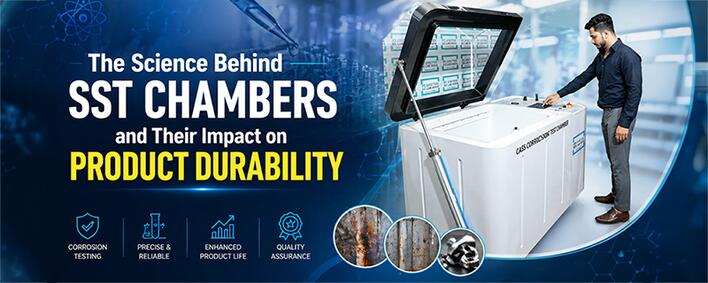
In today’s highly competitive manufacturing landscape, product durability is not just a quality parameter — it is a market differentiator. Whether you manufacture automotive components, aerospace parts, electrical fittings, or industrial coatings, ensuring that your products can withstand harsh environmental conditions is critical to building trust and reducing field failures.
One of the most reliable and scientifically proven methods for evaluating corrosion resistance is the Salt Spray Test, conducted in a Salt Spray Chamber. At Effective Lab India, we design and manufacture precision-engineered salt spray chambers that help industries simulate years of real-world corrosion exposure within a controlled laboratory setting — saving time, cost, and resources.
This article explores the science behind salt spray chambers, how they work, and why they play a vital role in improving product durability across multiple industries.
What Is a Salt Spray Chamber?
A salt spray chamber — also known as a salt fog chamber or corrosion test chamber — is a laboratory testing instrument used to simulate the corrosive effects of a salty, humid environment on materials and coated surfaces. The test exposes specimens to a fine mist of saline (salt) solution under controlled temperature and pressure conditions, accelerating the natural corrosion process.
This controlled acceleration allows manufacturers to evaluate the corrosion resistance of:
- Metallic components and alloys
- Painted and powder-coated surfaces
- Electroplated and anodized finishes
- Fasteners, bolts, and hardware
- Automotive and aerospace parts
- Electrical connectors and enclosures
What would otherwise take months or years of outdoor exposure can be replicated in a matter of hours or days inside a salt spray chamber — making it an indispensable tool in quality assurance laboratories.
The Science Behind Salt Spray Testing
Electrochemical Corrosion: The Core Principle
Corrosion is fundamentally an electrochemical process. When a metal surface is exposed to an electrolyte (such as a saltwater solution), an electrochemical cell forms on the surface. The metal acts as both the anode (where oxidation occurs) and contributes to a cathode (where reduction occurs), triggering electron transfer that leads to metal degradation.
The salt solution — typically a 5% sodium chloride (NaCl) solution — serves as a highly conductive electrolyte. This accelerates ionic movement across the metal surface, dramatically speeding up the oxidation and reduction reactions that cause rust, pitting, blistering, and coating degradation.
The Role of Temperature and Humidity
Inside an Effective Lab India salt spray chamber, temperature is precisely maintained — typically at 35°C (±2°C) as per international standards such as ASTM B117 and ISO 9227. This elevated temperature:
- Increases the rate of electrochemical reactions
- Enhances electrolyte conductivity
- Ensures consistent fog atomization
Relative humidity inside the chamber is maintained at near saturation (above 95%), ensuring continuous wetting of the test specimen surface — a critical factor in sustaining the corrosion reaction throughout the test cycle.